

How to Write Law Answers in CA Inter is one of the most important skills for students who want better marks in Corporate and Other Laws. The right answer format helps you present provisions, facts, keywords and conclusions in a way that is easy for the examiner to evaluate.
Knowing the law is only one part of scoring well in the CA Intermediate Law examination. You must also show the examiner that you understand the relevant provision, can apply it to the facts and can reach a clear legal conclusion.
The most effective answer-writing method is simple: state the relevant provision, apply it to the facts and finish with a precise conclusion. High-scoring answers are complete, readable and easy to evaluate. They use legal keywords, answer every sub-part and avoid unnecessary narration.
This guide rewrites and expands the practical lessons from CA Shubham Singhal’s analysis of rank holders’ answer sheets. It explains what strong CA Inter Law answers do differently and gives you a repeatable method for your next mock test and examination.
How to Write Law Answers in CA Inter: Best Format
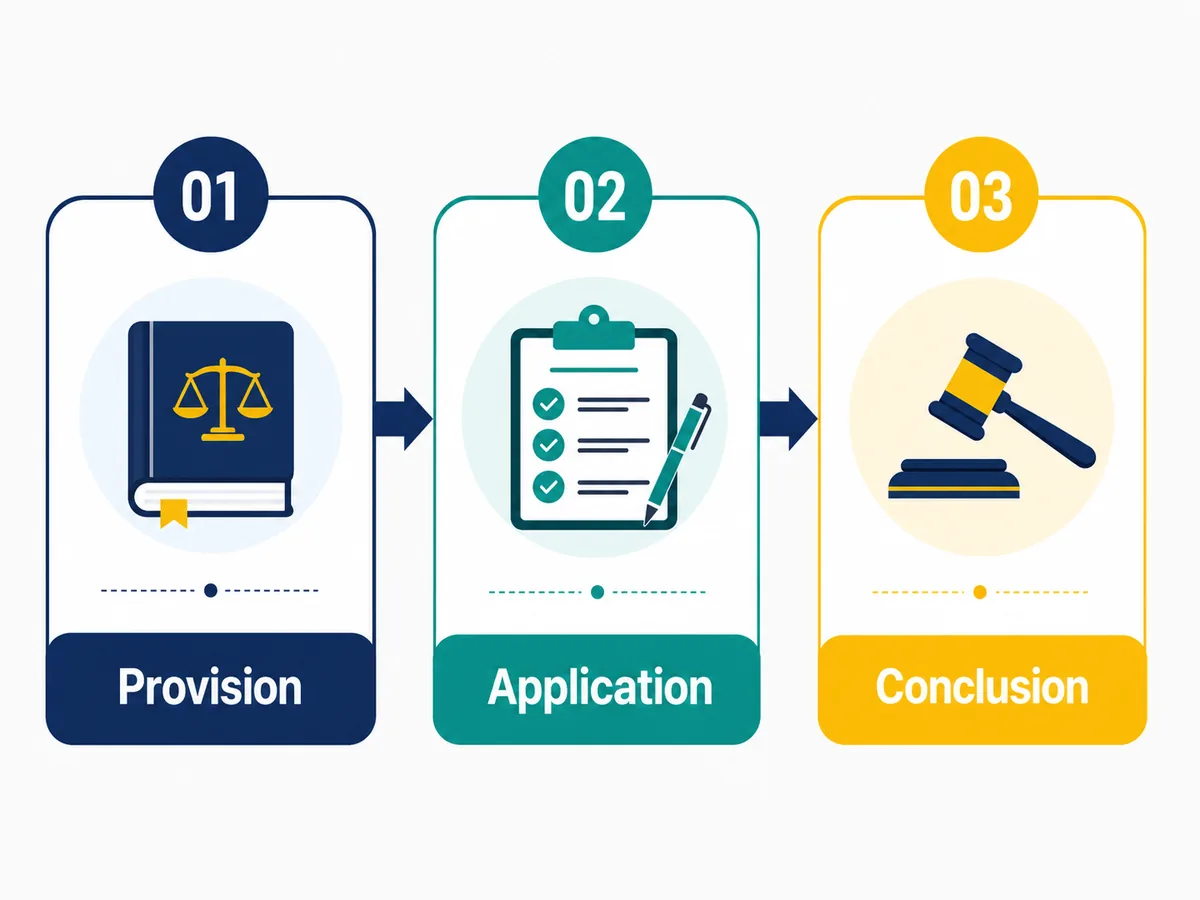
For a case-study question, use this three-part structure:
- Provision: State the applicable law and its essential conditions.
- Application or analysis: Connect each important fact in the question with the provision.
- Conclusion: Give a direct answer that follows logically from your analysis.
For a direct theory question, do not force a case-study format. Begin with the relevant provision, explain the required points in a logical order and directly address what the question asks.
The examiner should be able to identify your legal rule, reasoning and final answer within a quick scan.
Students searching for How to Write Law Answers in CA Inter should remember that presentation is not decoration; it is the process of making provisions, facts and conclusions visible to the evaluator.
Why Students Lose Marks Despite Knowing the Law
Two students may know the same chapter but receive very different marks. The difference often comes from execution rather than knowledge alone.
A student may lose marks by writing an unsupported conclusion, omitting a sub-part, providing only a calculation, using vague language or presenting the answer in a rushed manner. Another student may receive better marks with ordinary language because the answer contains the right legal keywords, follows a visible structure and covers the complete requirement.
The examiner is evaluating a large number of answer sheets. A clean structure helps the evaluator quickly locate the mark-worthy content. This does not mean adding decoration. It means making the substance visible.
What an Examiner Should See Immediately
- The correct question number and sub-part
- The applicable Act, provision, rule or legal principle
- Important statutory keywords
- Application of the law to the given facts
- A clear and legally consistent conclusion
The AIR-Style Provision, Application and Conclusion Method
1. Write the Relevant Provision
Start with the rule that governs the issue. Mention the section number when you are confident that it is correct. If you cannot recall the number with certainty, write the name of the Act, the relevant legal principle and the correct provision in words. A correct provision without a section number is better than a confidently written wrong section number.
Your provision should include the conditions that matter to the question. Avoid reproducing an entire chapter when only one legal requirement is being tested.
Useful opening: As per the relevant provisions of the Companies Act, 2013, …
Stronger opening when the section is certain: According to Section [number] of the Companies Act, 2013, …
2. Apply the Provision to the Facts
This is where many otherwise good answers become incomplete. Do not stop after stating the law. Identify the facts that trigger the provision and explain their legal effect.
Use the names given in the question. If the question refers to a company, director, partner or shareholder by name, use that name in your analysis. This shows that you are solving the case rather than reproducing a memorised note.
Useful transition: In the present case, [party] has …, which satisfies/does not satisfy the requirement that …
3. Give a Clear Conclusion
End with a direct response to the exact question. Use expressions such as:
- Therefore, the company is/is not permitted to …
- Accordingly, the resolution is/is not valid.
- Hence, the partner can/cannot be held liable.
- Consequently, the proposed action complies/does not comply with the applicable provision.
Your conclusion must agree with the provision and analysis above it. A contradictory conclusion can weaken the entire answer because it makes the examiner doubt whether the law was understood.
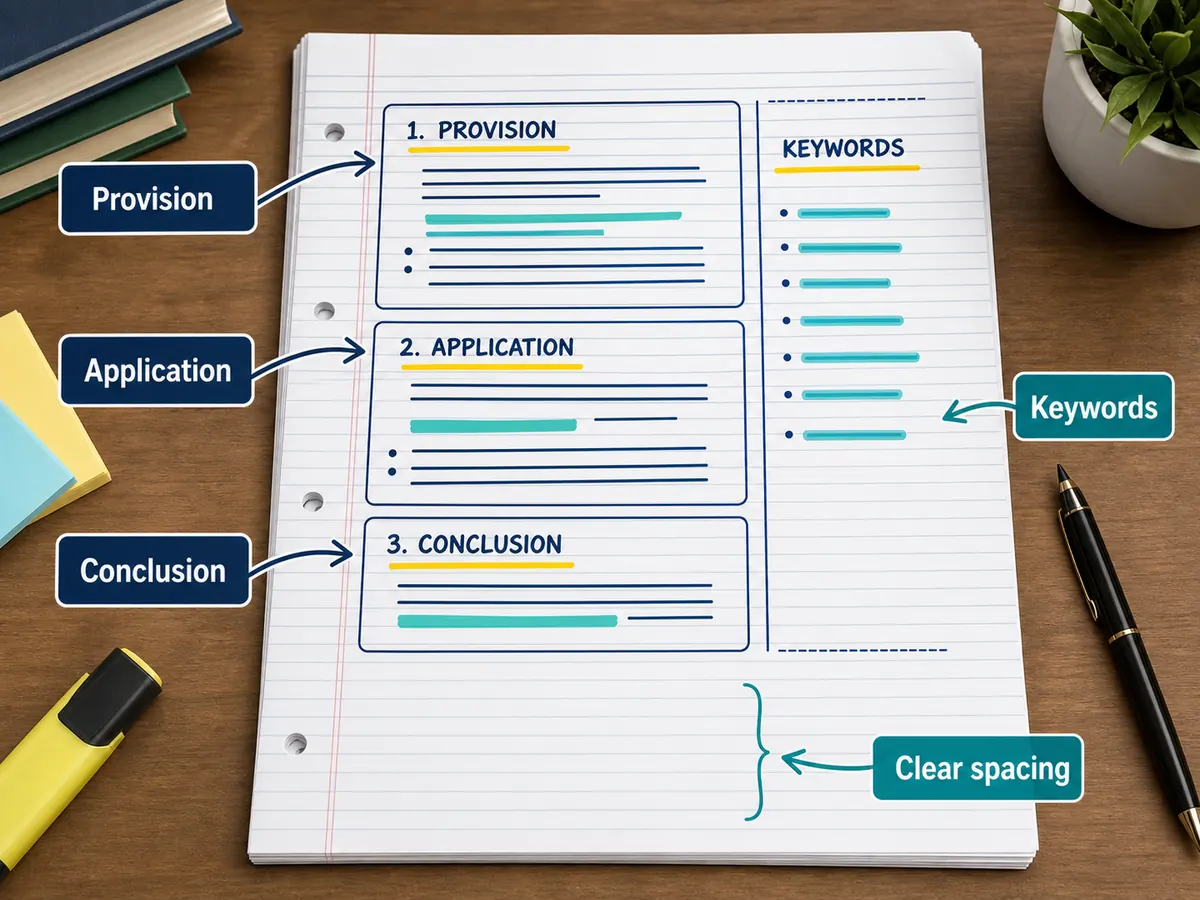
Model Case-Study Answer Template
Relevant Provision
As per Section [number, if certain] of the [name of Act], [state the legal rule, conditions, exception and consequence relevant to the question].
Analysis of the Present Case
In the given case, [identify the material facts]. Since [connect the first fact with the legal condition], and [connect any additional fact or exception], the applicable provision [is/is not] satisfied.
Conclusion
Therefore, [answer the question directly]. Accordingly, [state the legal result or liability in one precise sentence].
This format is a guide, not a rigid ritual. A short, direct theory question may not need separate “Analysis” and “Conclusion” headings. Match the structure to the nature of the question.

12 Answer-Writing Secrets Students Can Learn from Rank Holders
1. Begin with Your Best Answer
Unless the examination instructions require a particular sequence, start with the question you understand best. A strong first answer helps you settle into the paper and presents your best work while your concentration and handwriting are fresh.
Do not choose only by chapter familiarity. Choose a question for which you can recall the provision, address every sub-part and write a confident conclusion.
2. Decode the Requirement Before Writing
Read the requirement separately from the case facts. Identify whether the examiner wants you to state a provision, determine validity, calculate a voting requirement, advise a party, explain liability, discuss exceptions or answer multiple sub-parts.
Before moving to the next answer, compare what you wrote with what was actually asked.
3. Attack the Legal Twist
Most case-study questions contain one fact designed to test a specific exception, condition or consequence. Find that twist and address it directly.
For example, if a voting problem states that some members abstained, explain whether abstaining votes enter the relevant computation. Do not spend most of your time describing the entire law of meetings while missing the fact that determines the answer.
4. Use Legal Keywords, Not Memorised Bulk
An examiner can award marks more easily when the expected legal expressions are visible. Learn the terms that carry legal meaning in each provision, such as “personally present”, “collectively authorise”, “not less than”, “liable”, “notice”, “within the prescribed period” or “subject to”.
Use the closest accurate legal language you can recall. You may explain the application and conclusion in simpler language, but the core provision should retain its legal meaning.
5. Underline Selectively
Underline only the section number, essential legal phrase, numerical condition, exception and final result. Use the same pen permitted for the answer sheet and keep the page clean.
If everything is underlined, nothing receives emphasis. Selective underlining should help an evaluator scan the answer, not distract from it.
6. Write in Short, Logical Paragraphs
Break a long answer into readable units. Leave a small gap between the provision, analysis and conclusion. Use numbered points when the law contains separate conditions, exceptions or procedural steps.
Do not draw elaborate boxes or margins that consume time. Readability comes from spacing, headings and disciplined paragraphing.
7. Keep Handwriting Readable
Beautiful handwriting is not required. Clear handwriting is. Maintain a consistent size, leave enough space between words and avoid compressing the final answers because time is running out.
Writing practice should improve both speed and legibility. Speed that makes the answer difficult to read is not useful speed.
8. Cover Every Sub-Part
A five-mark question may contain two or three distinct requirements. Missing one requirement can cost marks even when the portion you attempted is correct.
Mark the sub-parts in the question paper and answer them in the same order. A conclusion with separate points such as “(i)”, “(ii)” and “(iii)” makes complete coverage easy to verify.
9. Write the Law Before the Calculation
In a question involving quorum, voting, time limits or another computation, the rule and the calculation earn marks for different work. State the relevant legal condition first, calculate using the facts and then interpret the result.
Only writing a number does not demonstrate why that number is legally correct. Even if your arithmetic goes wrong, a correct provision and method may still preserve step marks.
10. Never Write a Bare Conclusion
“Yes, the company can do so” is not a complete law answer. Support the result with the relevant rule and its application.
If you know only part of an answer, write the correct provision you remember, apply it cautiously and avoid inventing details. A supported partial answer has a better chance of earning marks than an unsupported guess.
11. Match the Length to the Marks
The best answer is complete, not endless. As a working practice limit, allow about two minutes per descriptive mark. A five-mark answer should usually be completed in roughly ten minutes, subject to your paper strategy and the latest ICAI instructions.
Use the available time to cover the legal rule, the facts that matter and the conclusion. Do not reproduce a suggested answer word for word.
12. Reserve Time for a Final Scan
Keep the final five to ten minutes for a rapid review. Check question numbers, unanswered requirements, section numbers, conclusions, missing calculations and pages where rushed handwriting became unclear.
How to Handle Different Types of CA Inter Law Questions
Direct Theory Question
Use a brief introduction followed by the relevant conditions, exceptions or procedure. Answer the exact command word. If the question asks you to “state”, do not add an unrelated case analysis.
Case-Study Question
Use Provision, Application and Conclusion. Mention only the facts that affect the legal outcome.
Question with Multiple Parties
Analyse each party separately. Liability may differ depending on notice, authority, retirement, consent or another fact. Use separate conclusions for each person.
Computation-Based Law Question
Write the governing rule, show the calculation and state the legal result. Mention any excluded category, exception or abstention that affects the computation.
Question Where You Do Not Recall the Section Number
Do not invent one. Identify the correct Act and legal principle, write the provision accurately and complete the application. Build a section-number revision sheet during preparation so that frequently tested provisions become easier to recall.
What Rank-Holder Answer Sheets Teach About Suggested Answers
ICAI suggested answers are comprehensive academic references. Your examination answer does not have to match their length or wording exactly.
Use suggested answers to identify the provision being tested, the conditions carrying marks, expected legal keywords, application of each material fact and the correct final conclusion. Then practise expressing those elements within the time available.
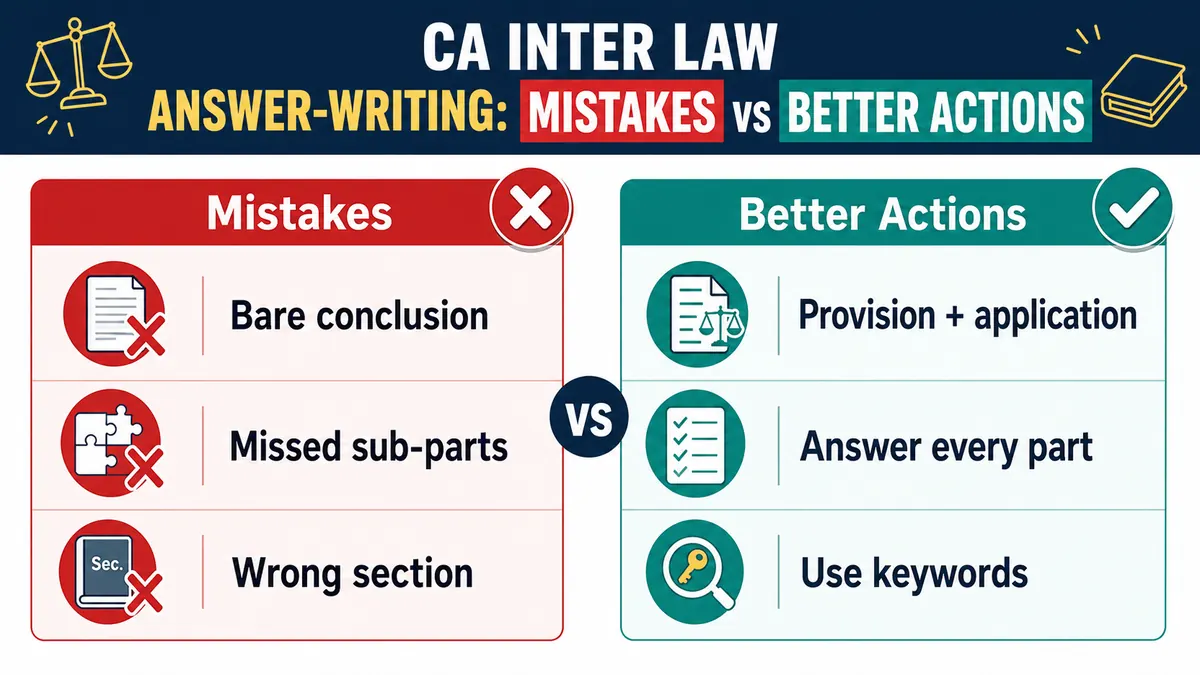
Common Mistakes That Quietly Reduce Law Marks
| Mistake | Why It Costs Marks | Better Approach |
|---|---|---|
| Writing only the conclusion | Shows no legal basis | Add the relevant provision and application |
| Writing only the calculation | Omits the governing legal rule | State the law, then compute and conclude |
| Copying all case facts | Consumes time without analysis | Use only facts that affect the result |
| Giving a wrong section number | Creates doubt about legal accuracy | Mention a number only when reasonably certain |
| Ignoring a sub-part | Leaves allocated marks unattempted | Recheck every requirement before moving on |
During revision, use How to Write Law Answers in CA Inter as a practice checklist: provision first, application next and conclusion last.
A Seven-Day CA Inter Law Writing Practice Plan
Day 1: Build a Section Map
Create a chapter-wise list of important sections, rules and key phrases. Revise the list twice instead of trying to memorise isolated numbers.
Day 2: Practise the Three-Layer Structure
Write five case-study answers using Provision, Application and Conclusion. Focus on making each layer visible.
Day 3: Improve Keyword Recall
Take ten provisions and reduce each to five or six essential legal expressions. Practise writing a complete explanation around those keywords.
Day 4: Train for Sub-Parts and Computations
Solve questions containing multiple requirements. Tick each requirement only after it has been answered.
Day 5: Work on Presentation
Rewrite three answers with better spacing, headings, selective underlining and readable handwriting. Compare the time taken.
Day 6: Attempt a Timed Descriptive Test
Use a strict time limit. Start with your strongest answer, maintain roughly two minutes per mark and reserve review time.
Day 7: Audit Your Answer Sheet
Check your test like an evaluator. Look for omitted provisions, weak application, unsupported conclusions, missed sub-parts and unreadable sections.
How to Write Law Answers in CA Inter: Scoring Checklist
Use this compact checklist whenever you practise How to Write Law Answers in CA Inter during mocks or self-study.
- How to Write Law Answers in CA Inter starts with identifying the exact legal issue before writing the provision.
- How to Write Law Answers in CA Inter requires applying the law to the names, dates, amounts and facts given in the question.
- How to Write Law Answers in CA Inter becomes easier when every answer ends with a clear conclusion linked to the provision.
- How to Write Law Answers in CA Inter should be practised under time limits so your final paper stays complete and readable.
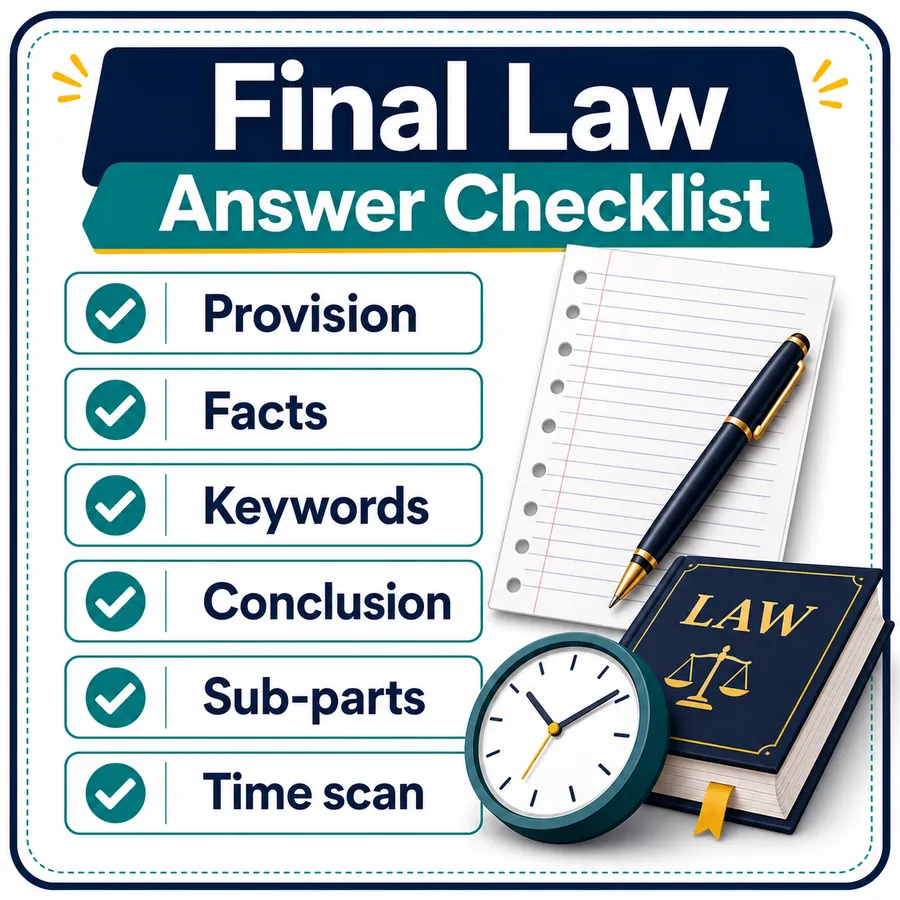
Final CA Inter Law Exam Checklist
- Did I write the correct question number and sub-part?
- Is the applicable provision clearly visible?
- Did I use the important legal keywords?
- Did I apply the law to the specific facts?
- Does my conclusion answer the exact requirement?
- Did I answer every sub-part?
- Did I show both the legal rule and the computation?
- Is my handwriting readable?
Frequently Asked Questions
What is the best format for writing CA Inter Law case-study answers?
Use three visible parts: the relevant provision, application of that provision to the facts and a direct conclusion. The conclusion must follow logically from the provision and analysis.
Should I start the CA Inter Law paper with Question 1?
Follow the examination instructions, but where choice and sequence are permitted, begin with the question you can answer most accurately and completely. A confident first answer also helps you establish a steady writing rhythm.
Is writing section numbers compulsory in CA Inter Law?
Section numbers improve precision when they are correct, but you should not invent a number. If unsure, write the correct Act, legal principle and provision in accurate words.
Can I score well without using the exact language of the law?
You do not need to reproduce every sentence verbatim. However, the core provision should contain the correct legal meaning and important statutory keywords. The application and conclusion may be written in clear, simple language.
How long should a five-mark CA Inter Law answer be?
There is no fixed page count. Write enough to cover the relevant provision, material facts, application and conclusion. As a practice benchmark, try to complete a five-mark descriptive answer in about ten minutes.
Does handwriting affect marks in CA Inter Law?
Handwriting does not need to be artistic, but it must be easily readable. Clear spacing, short paragraphs, visible headings and selective underlining help the examiner identify your points.
What should I do if I know only part of an answer?
Write the correct legal principle you remember, apply it only as far as the facts allow and avoid making up a section or rule. Attempt every relevant sub-part because supported partial work may earn step marks.
Should I copy the ICAI suggested answer in the examination?
No. Use suggested answers to learn the provision, keywords, reasoning and conclusion. In the examination, present those elements accurately and proportionately within the available time.
Final Takeaway
High marks in CA Inter Law come from making your legal knowledge easy to evaluate. Start with a strong answer, identify the issue, state the relevant provision, apply it to the facts and conclude without ambiguity. Use legal keywords, maintain readable presentation and answer every sub-part.
The most useful way to improve is not to read more writing advice. Select two changes from this guide, use them in your next timed answer and review the result. Once the structure becomes automatic, you can focus more of your exam time on legal reasoning.
This article is an original educational adaptation of the answer-sheet insights explained by CA Shubham Singhal in the video titled How AIRs Write Law Answers | Top Secrets to Scoring High | CA Inter.
CA Study Shop provides classes & books for CA CS CMA Students. We have partnered with more than 100 top faculties of country and provide excellent customer support which is evident from our 4.9/5 star rating on Google. Student can connect with us via any mode here.
Best of luck!
Stay Connected for more authentic updates.
Jai Hind,Vande Mataram
Team CA Study